How I Migrated 170k Users from PHP to Node.js Without Stopping the World
In 2025, I joined the RBL team, a dating platform that had been running since 2015. The original goal was simple: improve filtering, fix location-based matching, and assess whether the system could keep scaling.
At the time, the platform had over 170,000 users running on a legacy PHP + MySQL stack. I was hired to add features, but once I dug into the codebase, it became clear the system had hit a hard ceiling.
The “WTF” Moments
We all know that feeling when you open a legacy codebase and realize standard feature requests are going to be nightmares. Two things stood out immediately:
1. Location matching wasn’t real geo-spatial matching
There was no concept of coordinates or radius-based search. Location was inferred by extracting city names from IP addresses using a paid third-party service, then doing string comparisons. If User A was in “Accra” and User B was in “Accra”, they matched. Anything like “people within 50km” was impossible.
2. Extreme over-normalization
The database schema was rigid to the point of hurting read performance. Simple attributes like height weren’t stored as numbers. There was a separate heights table (1ft, 1.2ft, … 8ft) and user profiles referenced it via foreign keys. Fetching a single profile required joins across tables for height, hobbies, education, and more. Reads were slow, and the schema made iteration painful.
At that point, patching felt irresponsible.
The Rewrite
I made the case to stakeholders that this wasn’t a refactor problem. It was a rewrite problem. The new direction:
- Node.js (Express) for better concurrency
- PostgreSQL with PostGIS for proper geospatial queries
- A flatter schema optimized for reads
- Refactored the mobile client to be modern React Native compatible.
I spent about three months rebuilding the system end-to-end.
- Backend: Moved from PHP to Node.js (Express).
- Data: Moved from MySQL to PostgreSQL (flattened schema, enums instead of join tables, implemented proper geospatial indexing with PostGIS).
- Mobile: Moved client from Legacy React Native to modern React Native.
The Migration (The Scary Part)
The platform had 170k active users. I couldn’t flip a switch, shut down PHP, and assume everyone would update their app overnight. So I didn’t.
Instead, I built a dual-write proxy.
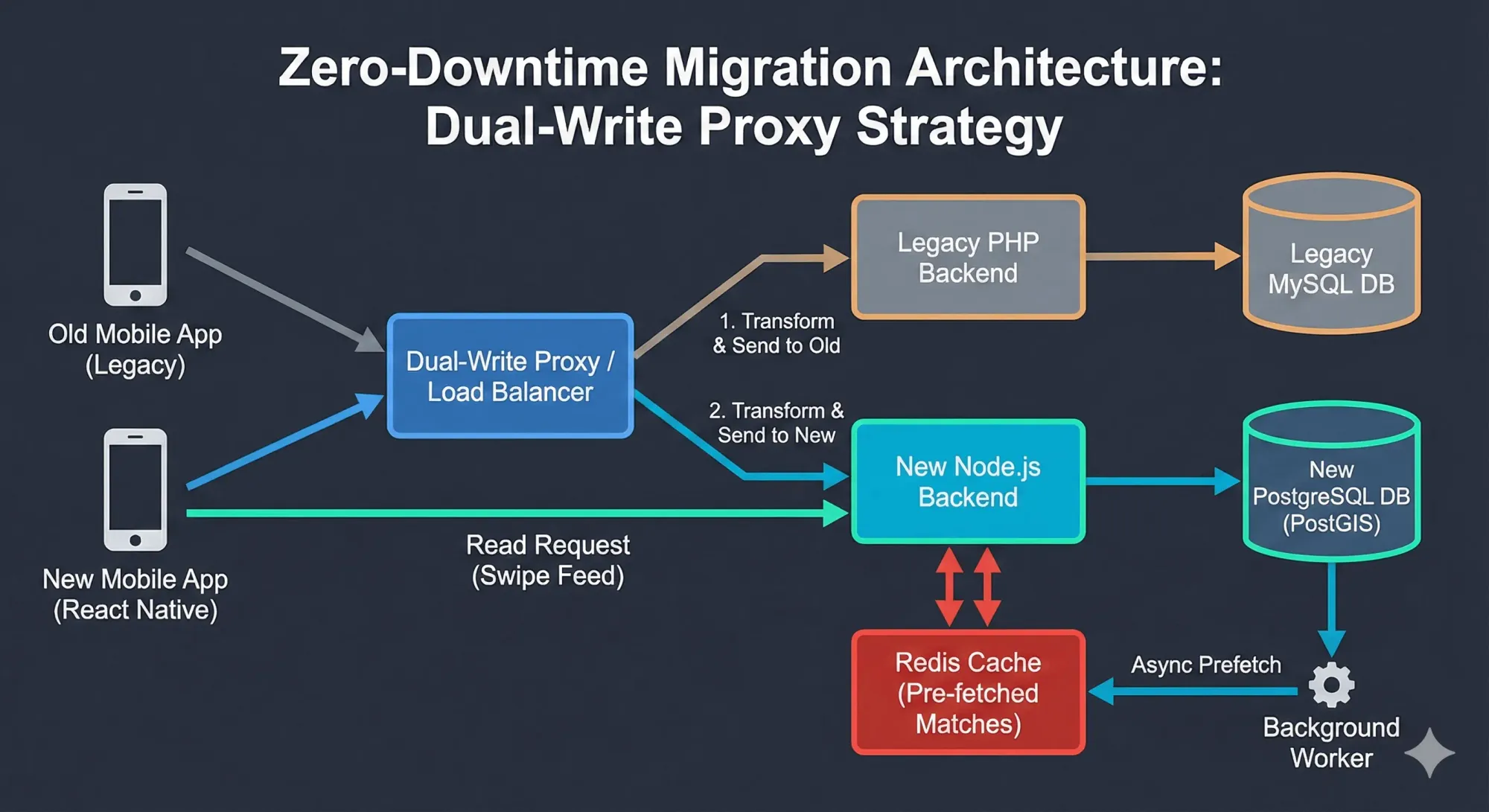
This middleware sat in front of both the old and new backends. When a user on the legacy app updated their profile (for example, changing their bio), the proxy would:
- Validate the request
- Transform the payload to match the new PostgreSQL schema
- Send it to the new Node.js backend
- Transform it again and forward it to the old PHP backend
Both systems stayed in sync, while a separate job backfilled historical data.
A user on the old app could chat with a user on the new React Native app without realizing they were on completely different backends.
Once adoption crossed a safe threshold, I finally shut down the PHP server.
Post-Launch & The 6-Second API Call
After launch, everything looked good… until traffic ramped up.
The “swipe” endpoint started timing out. Some requests took up to 6 seconds.
The cause was straightforward and painful:
I was running the full matching algorithm — geo filtering, compatibility scoring — on-demand every time a user requested a card.
At this scale, that doesn’t fly.
The Fix: Redis + Prefetching
I introduced Redis and changed the model entirely.
Instead of computing matches in real time:
- When a user opens the app, a background job precomputes their next batch of matches
- The results are cached in Redis
- The API simply reads from cache
Response times dropped from seconds to milliseconds.
The Result
Today, the platform:
- Supports 200,000+ users
- Has real radius-based geo filtering
- Uses a schema that doesn’t require 10 joins to read a profile
- Runs on a stack that can actually scale without fear
More importantly, the migration happened without downtime and without breaking the experience for existing users.